European Roulette Online in the UK: Odds and Play
 Available in GB
A guide to the single-zero wheel, bet payouts, online play formats and the differences between European and other roulette games.
Table of Contents
- European Roulette: One Zero, One House Edge
- Reading the European Roulette Table
- Single-Zero Roulette Bets and Payouts
- Playing Online: Practice, Real Money and Bonus Terms
- How to Assess a European Roulette Casino
- Where to Find European Roulette Online
- Live Dealer Roulette: The Wheel on Screen
- Roulette-Themed Slots Are a Different Game
- European, American and Lightning Roulette Compared
- How to Play European Roulette Without Treating Chance as a System
European Roulette: One Zero, One House Edge
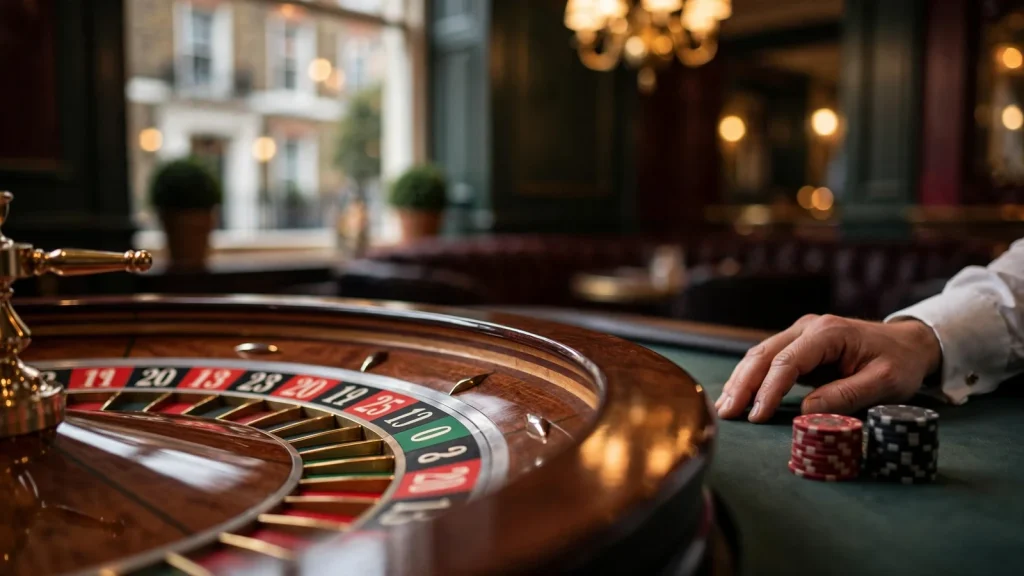
European roulette is built around a wheel with 37 pockets: the numbers from 1 to 36 and one pocket marked zero. That single green zero is the detail that defines the standard European layout and shapes its odds. The numbered pockets are not the whole story: the zero is part of the outcome set, even when a bet is placed on a group of numbered results.
The wheel and the betting layout serve different purposes. The wheel determines which pocket the ball reaches; the layout is where a player records a chosen outcome. For the basic question of odds, what matters is that the wheel has 37 possible pockets and that the zero is one of them. It is not an extra result outside the game, nor does it disappear when a bet is focused on the numbered outcomes.
That distinction explains the house edge. European roulette has a house edge of 2.70%. In plain terms, this is the casino’s mathematical advantage built into the game over repeated play, not a prediction of what will happen in a particular session. A spin can produce a result that favours a player, and a run of results can look very different from the long-term calculation. The edge describes the structure of the game, not a schedule for individual outcomes.
Choosing a UK online casino for European roulette involves more than the game itself: withdrawal timing can also matter. Use this list as a reference when considering payout speed.
1. Zombillion
Payout speed: 1-3 business days Zombillion lists a payout speed of 1–3 business days. Check whether that timing suits you when choosing where to play European roulette.
2. Revery Play
Payout speed: 1-3 business days Revery Play lists a payout speed of 1–3 business days. This gives you a stated timeframe to consider alongside your roulette preferences.
3. Amunbet
Payout speed: 1-3 business days Amunbet lists payouts as taking 1–3 business days. You can use that timing as one factor when considering this operator for European roulette.
4. EvoSpin
Payout speed: 1-3 business days EvoSpin gives a payout speed of 1–3 business days. Keep that stated timeframe in mind as you assess your options for European roulette.
5. Dieselwin
Payout speed: 1-3 business days Dieselwin lists a payout speed of 1–3 business days. That is the available practical detail to consider when looking at this operator.
6. Chanze
Payout speed: 1-3 business days Chanze lists payouts as taking 1–3 business days. If payout timing matters to you, this stated range may help inform your choice.
7. BeOnBet
Payout speed: 1-3 business days BeOnBet lists a payout speed of 1–3 business days. Consider that timeframe when weighing this option for European roulette.
8. WinBeast
Payout speed: 1-3 business days WinBeast states a payout speed of 1–3 business days. You can factor this information into your decision about where to play.
9. Britsino
Payout speed: 1-3 business days Britsino lists a payout speed of 1–3 business days. This stated timeframe is the available detail to consider for this operator.
10. SpinFormula
Payout speed: 1-3 business days SpinFormula lists payouts as taking 1–3 business days. Keep that timing in mind as you consider this option for European roulette.
The zero is central to that structure because it gives the wheel a result that is separate from the numbered pockets. Many roulette bets are framed around outcomes such as a particular number, a colour or a broad group of numbers. When the ball lands on zero, it does not become one of the numbered results simply because a player has chosen a broad category. The single zero therefore affects the chance of a bet succeeding and, in turn, the balance between the possible return and the risk taken.
This is why the European wheel’s single zero matters more than its colour or position on the layout. A player may find a particular arrangement easier to read, but visual familiarity does not change the odds. The zero remains an available outcome whenever a spin is made. It is also why identifying the roulette variant is useful before play: the same name, “roulette”, can describe wheels with different numbers of pockets and therefore different mathematical conditions.
For someone looking at European roulette in an online casino, the core feature is consistent whether the wheel is presented on a screen or in a streamed setting: the European version has one zero alongside the numbered pockets. The appearance and pace of a game can vary between formats, but they do not alter the meaning of the single-zero structure. Details of how online formats work are a separate matter; the first point is simply to know which wheel the game uses.
The 2.70% house edge is a useful comparison point, but it should not be mistaken for a personal forecast. It does not mean that a casino takes the same share from every stake, nor does it say when a player will win or lose. It is a theoretical measure of the advantage created by the rules across repeated outcomes. In a short session, chance can produce results that depart sharply from that long-run expectation. The edge remains part of the game even when it is not visible in the immediate result.
Online Casino Tournaments UK: Free Entry Explained
A single zero does not make roulette predictable. It makes the European version mathematically distinct from versions with additional pockets, while leaving each spin uncertain. No pattern in previous results can establish where the next ball will land: each outcome is determined by chance. That point matters because a wheel can appear to favour a colour or number over a stretch of play, but the appearance of a pattern does not remove the zero or change the game’s underlying edge.
If you are comparing European roulette games, begin by confirming that the title refers to the single-zero wheel rather than relying on a generic roulette label. Then keep the two ideas separate: the wheel’s pocket count describes the possible outcomes, while the house edge describes the casino’s long-term mathematical advantage. Together, they provide a clear starting point for understanding the European version without implying that any individual spin can be forecast.
Reading the European Roulette Table
A European roulette table has two connected parts: the numbered betting grid and the areas around it for broader selections. The grid mirrors the wheel’s set of 37 pockets: numbers 1 to 36, plus a single zero. On the layout, the numbered spaces form three vertical columns, with the zero set apart at one end rather than placed in a numbered row.
Each number occupies its own rectangle. The gaps and borders between rectangles matter: a chip placed in the middle of a space marks one number, while a chip set on a boundary can cover the spaces that meet there. The printed lines are the table’s map, so look closely at where a chip rests before a spin. A crowded screen or a small mobile display can make neighbouring spaces look closer than they are.
French Roulette Online in the UK: Rules and Play
Outside the grid, labels group numbers into wider categories. You will usually see areas for red and black, odd and even, and low and high numbers. The low and high sections divide the numbered range, while separate boxes marked for dozens and columns sit beside the main grid. These labels are not extra numbers; they refer to groups already represented on the numbered layout.
The zero has a separate space and does not belong to the red/black, odd/even or low/high groups. That makes its position easy to overlook when scanning quickly across the outside areas. Before selecting a category, identify the exact label and the part of the grid it refers to. The betting interface may highlight a region when you tap it, but the highlight is worth checking rather than treating as decoration.
On an online European roulette casino table, the same basic layout appears in digital form. A game may show the full table, or let you enlarge or scroll across it, especially on a phone. The wheel and betting grid can appear side by side, but the grid remains the reference for placing chips. Controls for stake size, clearing selections or repeating a previous layout may sit around it; these are interface tools, not part of the numbered arrangement.
Learning the table layout is useful, but it is not a European roulette strategy. Recognising a row, column or outside area tells you where a selection is placed; it does not make the next result more predictable. Get comfortable with the printed divisions first, then consider what each selection means and what it pays.
Single-Zero Roulette Bets and Payouts
On a European roulette table, a bet can cover one number or a group of outcomes. The payout reflects the type of bet, but it does not change the underlying chance of the ball landing on a particular pocket. The main distinction is between inside bets, placed on numbered outcomes, and outside bets, which cover broader groups.
Inside Bets
Bets placed on specific numbers or small groups of numbers, offering higher payouts but lower probabilities of winning.
Outside Bets
Bets covering broader categories like red/black or odd/even, providing lower payouts but higher probabilities of winning.
Inside bets
Inside bets focus on numbers. A straight-up bet selects one number; if it wins, it pays 35:1. That is the quoted profit relative to the stake, with the original stake also returned. A single-number bet offers a larger payout than a bet covering several numbers, but it is harder to win because it depends on one precise result.
A split bet covers two adjacent numbers and pays 17:1. You place it across the line between those numbers, so either result wins. A street bet covers a horizontal row of three numbers and pays 11:1. These options widen the set of numbers that can win while reducing the payout compared with a straight-up bet.
The European single-zero table also allows other ways to cover groups of numbers. Before placing any inside bet, check the markings on the table and the game’s paytable: the bet’s coverage and its stated return should be clear. A larger group may feel less exposed than a single-number selection, but that does not make it a prediction.
Outside bets
Outside bets cover categories rather than individual numbers. Red or black, odd or even, and low or high are the familiar even-money choices. Each pays 1:1: a winning stake earns an equal amount, and the stake is returned as well.
These bets cover many numbers, but they do not cover every possible result. Zero is green, so it is not red or black; it is also neither odd nor even, and does not belong to either the low or high group. That exception matters because a zero result can turn an otherwise winning-looking outside selection into a loss under the standard rule.
Online Casino Without ID in the UK: What to Expect
What La Partage changes
Some European roulette tables apply La Partage to even-money bets. If the ball lands on zero, half of an affected red/black, odd/even or high/low stake is returned rather than lost in full. The rule does not turn zero into a winning result for those bets; it reduces the loss.
With La Partage, the house edge on those even-money bets is 1.35%. That is lower than the edge on a comparable bet without the rule, but it remains an advantage for the casino. The distinction is specific to the even-money selections: do not assume that La Partage refunds part of a losing inside bet.
Check the table rules before staking. Two games can both use a European wheel and offer the same basic betting choices, yet differ in whether La Partage applies. The payout shown for a bet tells you what a win returns; the rule for zero tells you what happens when that pocket lands instead.
Playing Online: Practice, Real Money and Bonus Terms
A free European roulette game lets you try the interface without staking cash. It may be labelled “demo” or “play for fun”, and typically uses a balance that has no cash value. Any winnings shown in that mode cannot be treated as money available to withdraw. Check that you have selected the free-play option before starting: real-money games use funds in your gambling account, and their results can affect your balance.
For real-money European roulette, the rules and displayed payouts are not the only terms to consider. Operators may set minimum and maximum stakes, while bonus terms can determine whether a roulette wager helps meet a wagering requirement. These are separate questions: being able to place a cash bet does not mean that the bet will count fully towards a bonus.
Attention: Bonus funds are promotional and governed by specific conditions, which differ from free-play demo modes and real-money balances.
Game weighting is the share of a qualifying wager that counts towards the requirement. The rate can depend on both the operator and the roulette format. One specialist review reports that live roulette may count at 10% or 20%, while RNG roulette may count at 100%. Treat those figures as an indication of how terms can differ, not as a rate that applies at every casino. The operator’s own bonus terms should state whether roulette is eligible, which formats count, and what weighting applies.
A low weighting can make roulette a slow way to clear a bonus: only part of each qualifying stake may count. Live roulette may also be excluded from a particular offer altogether. If a term is unclear, do not assume that a game labelled roulette qualifies; check the offer conditions or ask the operator before playing with bonus funds. Bonus funds can also be subject to restrictions that do not apply to ordinary cash in your account.
A regulatory summary reports that, since January 2026, UK rules cap bonus wagering requirements at a maximum of 10x for all licensed operators. That cap does not make every offer equally useful, nor does it remove the need to read its game-weighting rules. A requirement at the permitted ceiling can still involve substantial qualifying play, especially where roulette wagers count only in part.
Online Bingo in the UK: Rooms, Tickets and Slots
Free play and bonus play are not the same thing. A demo game uses no deposited stake, while bonus funds are promotional funds governed by the offer’s conditions. Real-money play, meanwhile, exposes your own balance to wins and losses. Operators must verify your age before allowing you to deposit into a gambling account. Before switching from a demo to a cash table, confirm which balance is being used and whether any bonus terms apply.
How to Assess a European Roulette Casino
A polished roulette page does not establish that an operator is suitable. Before comparing game menus or deciding where to play, check who runs the site, whether it is authorised to serve the British market, and whether you can find the information and controls needed to make an informed choice. Those checks are more useful than an unsupported “best casino” label.
Confirm the operator’s status
The UK Gambling Commission (UKGC) is the regulator responsible for online casino activity in Great Britain. A company offering real-money gambling to customers there must hold the relevant UKGC operating licence, even if the company is based elsewhere. A site without a valid UKGC licence cannot legally offer real-money roulette to British residents.
Look up the operator on the UKGC’s public register and check that the licence is current and covers the activity being offered. Do this before depositing, rather than relying on a logo or a statement in the site footer. Check that the business name on the register corresponds to the operator named in the site’s terms. If those details do not line up, pause and seek clarification before creating an account or sending money.
Verify Operator Status
- Search for the operator on the UKGC public register
- Confirm the license is current
- Match the business name on the register with the site terms
- Ensure age verification procedures are clear
Operators must verify your age before allowing you to deposit. The account process should make clear what information is required and how identity checks work. Treat unclear ownership, licensing details or verification procedures as reasons to investigate further, not as minor presentation issues.
Look for usable game information
For a roulette game, find the return-to-player (RTP) information before you play. RTP is a theoretical measure of the proportion of stakes a game returns over a very large number of plays; it does not predict what will happen in an individual session. The operator should make the relevant information accessible, rather than leaving you to search through unrelated pages or guess which version of a game is on offer.
Read the game’s own rules and paytable as well. Confirm that the displayed game is the European roulette format you intended to open, and check which rules apply at that table. A familiar name or visual design is not a substitute for the game information shown by the operator. If the RTP or rules are difficult to locate, that is a practical reason to withhold a deposit until you can get a clear answer.
Test the account controls
Responsible-gambling tools should be visible in the account area and understandable before you need them. UKGC-licensed operators must offer deposit limits, loss limits, session-time reminders, reality checks, cool-off periods and GamStop self-exclusion. These controls serve different purposes: limits can restrict account activity, reminders help you keep track of time, and self-exclusion is a way to block access to gambling services for a chosen period through the scheme.
New customers must be prompted to set a financial limit before making their first deposit. Operators must also provide accessible account-level controls for setting or changing limits. Check where those controls sit and whether the instructions explain how they work. A tool that exists but is difficult to find is less useful when you want to use it.
Live Dream Catcher Casino in the UK: What to Check
Do not treat the availability of controls as evidence that gambling is risk-free. They are safeguards, not a way to make roulette predictable or to remove the possibility of losing money. If you want to stop using gambling services, GamStop self-exclusion is among the protections UKGC-licensed operators must provide.
Know how to raise a complaint
Before playing, find the operator’s complaints procedure and note how to submit a complaint and what information it asks you to provide. UKGC licensees must offer an internal complaints process and access to an approved Alternative Dispute Resolution (ADR) service. The usual route is to raise the issue with the operator first; if it remains unresolved, the operator’s published procedure should explain how to take it to the relevant ADR service.
A clear complaints page should identify the steps and the independent dispute-resolution option. If you cannot find that route in the site’s help or terms pages, ask the operator to point you to it before depositing. You should not have to rely on a chat agent’s informal assurance to learn how a dispute can be reviewed.
No single feature makes one casino the right choice for everyone. Use licensing, accessible game information, practical account controls and a clear complaints route as checks you can verify. A separate comparison can help you identify operators to examine, but the final decision should rest on details you can confirm yourself—not on a ranking that offers no evidence.
Where to Find European Roulette Online
When looking for European roulette online, the main choice is often how the spin is produced. Random number generator (RNG) roulette uses software to simulate the result. Live roulette shows a physical wheel and ball through a video stream. Both can offer the same type of game, but the experience and pace differ.
RNG roulette: a quicker, simulated spin
In an RNG game, a random number generator selects the outcome; there is no physical wheel for you to watch. The game can move directly from one spin to the next, so play is faster than at a streamed table. RNG games can also have lower minimum stakes, with some starting at 10p. That may suit you if you want to play at a modest stake or prefer not to wait between rounds.
The quicker pace is worth considering before you start. More frequent spins can make it easier to lose track of how long you have been playing. A lower minimum stake does not change that: decide what you are comfortable spending and use the account controls available to manage your play.
Live roulette: a streamed physical wheel
A live game broadcasts a real wheel from a studio, where a dealer spins the wheel and releases the ball. You watch the ball land rather than seeing a software-generated result presented on screen. The stream and dealer add time between spins, making the rhythm less immediate than RNG play.
Some live tables are designed to move faster. Speed roulette is one such format, but its pace is not the same everywhere. A specialist review reports more than 150 spins per hour for speed roulette, compared with 80–100 at a standard table. Treat those figures as a comparison reported by that type of source, not as a promise about every table. The actual pace depends on the game you open.
What to check before opening a table
The game’s label should make clear whether it is RNG or live. If it does not, read the description before placing a bet: a video stream indicates a live table, while a simulated interface indicates RNG play. The lobby may also separate the formats or let you filter the games, though the layout differs between operators.
If you want to watch a dealer and a physical European roulette wheel, look for a live table. If you value a quicker sequence of simulated spins or a lower listed minimum, RNG roulette may be a better fit. Neither format changes the importance of reading the table information and checking the stake before confirming a bet.
Do
- Check if the game is RNG or Live via the description
- Compare displayed minimum stakes before joining
- Verify the operator holds a valid UKGC licence
Don’t
- Assume the format based on a generic roulette label
- Expect a specific pace from every live table
- Deposit into a platform without UKGC authorisation
A casino with European roulette may list several tables rather than one. Compare the game descriptions and displayed minimums, and make sure the table is the format you intended to open. A live stream can make a game feel more like a shared event; an RNG screen keeps the focus on the sequence of spins. The distinction is practical, not a prediction of which format will produce a particular result.
Whether you choose a simulated game or a streamed wheel, check that the operator is authorised to offer real-money gambling to British customers. A platform without a valid UK Gambling Commission licence cannot legally offer real-money live roulette to British residents.
Live Dealer Roulette: The Wheel on Screen
A live European roulette table brings a physical wheel into the online game. A camera streams the studio, where a human dealer sets the wheel in motion and releases the ball. You watch the result rather than relying on a software-generated animation. The screen may also show the dealer and the table, so the pace is shaped by the physical spin and the steps needed to settle each round.
The broadcast does not make the game less dependent on chance, and a polished studio is not evidence that an operator is authorised to serve you. In Great Britain, real-money live roulette may be offered only by a platform holding the relevant UK Gambling Commission licence. A site without a valid UKGC licence cannot legally provide this service to British residents. Check the operator’s licence number against the Commission’s public register before depositing; the operator must also verify your age before it allows a deposit.
There is no single minimum stake across live tables. A specialist review reports that some UK live roulette tables open at 10p, while auto-roulette or speed formats may be available from 5p. These are reported starting points, not a promise that a particular table will offer them: check its displayed limits before joining.
UKGC-licensed live casino operators must provide tools to help you manage gambling. These include deposit and loss limits, session time reminders and reality checks, which interrupt play to make your time or activity visible. Operators must also offer cool-off periods and GamStop self-exclusion. A cool-off period lets you take a break; self-exclusion through GamStop is a stronger step for preventing access to participating gambling sites. Set limits at account level where available, and use them before play rather than waiting until a session feels difficult to control.
Operators must prompt new customers to set a financial limit before their first deposit and make account-level limit controls accessible. If you choose to play, check what controls the operator offers and how to activate them. A live stream can make a session feel like a continuous visit to a table, but the safeguards are there to give you ways to pause, restrict deposits or step away. The dealer’s presence does not replace those controls, and using them remains your decision.
Roulette-Themed Slots Are a Different Game
A slot with roulette in its name or artwork is not the same product as an online European roulette table. The table game uses a wheel and a ball; a slot is a separate casino game presented through a digital reel display. A roulette theme may influence the graphics or wording, but it does not establish that the game uses a roulette wheel, its betting areas or its payouts.
That distinction matters if you are looking for a particular experience. A title described as a three-dimensional European roulette slot may sound like a wheel game rendered in detailed graphics. The description alone does not confirm how the game works. The same applies to names such as European Roulette Gold or European Roulette Platinum: words suggesting a version or edition are not evidence that the product follows standard European roulette rules.
In a conventional European roulette game, the odds relate to the wheel’s 37 pockets, numbered from 1 to 36 with one zero. A slot’s results and any return information belong to that individual slot, not to the roulette wheel. You should not carry the wheel game’s odds or payout table across simply because a slot borrows its name or appearance. Check the game information provided by the operator if you need to understand a slot’s own rules and return details.
There is a practical difference in how the games are played, too. Roulette asks you to choose where to place a bet on a table before a spin. A slot presents its own controls and game rules. A roulette-themed image does not make those controls or rules equivalent. If the product page does not clearly identify the game as a roulette table, treat it as a slot rather than assuming it offers roulette betting.
UK rules for online slots also differ from what a roulette label might suggest. Autoplay is not permitted for online slot play in Britain, and each slot spin must last at least 2.5 seconds. The maximum stake per game cycle is £5 for customers aged 25 and over, and £2 for those aged 18 to 24. These are slot rules, not roulette table limits.
So, if you want the standard wheel game, look for a roulette table explicitly described as European roulette. If you choose a slot with roulette styling, assess it as a slot and rely on its own published game information—not on assumptions drawn from the wheel game.
European, American and Lightning Roulette Compared
The clearest difference between European and American roulette is the number of pockets on the wheel. European roulette has 37: numbers 1 to 36 and one zero. The American wheel adds a double zero, bringing its total to 38 pockets. That extra green pocket changes the odds against the player.
The house edge is 2.70% on European roulette and 5.26% on American roulette. The house edge is the mathematical advantage built into the game over time; it does not predict the result of an individual spin. If you are choosing between the two formats, the single-zero wheel has the lower edge.
American roulette also has a bet covering zero, double zero, one, two and three, known as the basket bet. Its house edge is 7.89%, higher than the edge on other bets in the same game. The name may sound like a way to cover several outcomes efficiently; the odds make it a costly choice.
The American roulette wheel includes a double zero (38 pockets total), which increases the house edge to 5.26% compared to 2.70% in European roulette.
Lightning Roulette keeps the European-style single-zero wheel but adds randomly selected number multipliers. A specialist review reports that a straight-up bet—that is, a bet on one number—pays 29:1 when no lightning multiplier applies, rather than the 35:1 payout on a standard European or American wheel. Treat that as a feature to confirm in the rules for the specific game you open, not as a payout that applies to every Lightning Roulette version.
These formats are all roulette, but their pay tables are not interchangeable. In particular, the American wheel’s second zero affects the game’s overall edge, while Lightning Roulette changes the straight-up payout when no multiplier is active. Check the displayed rules before placing a bet, especially if you have moved between formats and expect the same terms.
How to Play European Roulette Without Treating Chance as a System
To play European roulette online, start by choosing a stake you can afford to lose, then select a position on the betting layout before the spin. You can cover one number or a group of numbers, or choose an outside bet such as red or black. The choice affects the payout if your selection wins; it does not give you control over where the ball lands.
A straight-up bet selects one number. Its payout is 35:1. A split covers two adjacent numbers and pays 17:1, while a street covers a horizontal row of three and pays 11:1. Red or black, odd or even, and high or low are even-money bets, paying 1:1. These are different ways of distributing a stake across possible outcomes, not different ways of changing the wheel’s odds.
Before confirming a wager, check that the selected chips and positions match what you intend to bet. On a digital game, a mistaken click can put a chip somewhere other than the intended number or group. If the interface lets you clear or repeat bets, make sure you understand what those controls do before relying on them. A repeated layout is simply the same wager again; it does not become more likely to win because it won previously.
Free-play versions can help you learn how the controls work without staking real money. Treat that as practice with the interface, not a test that predicts future results. When you move to real-money play, the same underlying uncertainty remains. The European wheel’s result is determined by chance, and neither a run of wins nor a run of losses tells you what the next spin will do.
That is why betting progressions are not forecasting systems. The Martingale, for instance, calls for doubling a wager after each loss, on the assumption that a later win can recover earlier losses. But a sequence of losses can keep extending, and each increase puts more of your bankroll at risk. A losing streak can damage a bankroll before a recovery arrives; no progression removes that possibility or makes a particular number due.
A practical approach is to decide in advance how much of your available bankroll you are prepared to spend, and stop when it is gone or when you have reached your own stopping point. Do not raise stakes to chase losses or treat a previous result as evidence for the next one. This is not a method for improving the odds; it is a way to keep a chance-based game within a boundary you have chosen.
European roulette payouts can look precise, but a payout describes what a winning selection returns, not how often you should expect it to win in a short session. Even a straight-up selection that pays 35:1 can lose on the spin in front of you. Whether you choose a simple outside bet, a single number or a practice game, the useful distinction is between placing a wager and believing you have found a system. The first is a choice; the second is a promise roulette cannot make.
Real Money Slots: DazzleCasino UK Games and Software

Real Dealer Tables: DazzleCasino UK Live Casino
DazzleCasino has a live casino section, and the current official site navigation still exposes a...

Aviator Casino Game UK: Sites, Rules and Risks
Explore how licensing, game classification and site claims shape the options available for playing Aviator...

3-Reel Slots in the UK: How to Choose a Game
Three-reel games can resemble other classic-style slots, so check the game information and rules before...

5-Reel Slots in the UK: Rules, Features and Play
Game rules explain how combinations are judged, what symbols do and how listed outcomes relate...

Bonus Buy Slots in the UK: Features and Demo Play
A practical guide to bonus-buy mechanics, demo play and the slot features that shape the...

Fast Payout Online Casinos in the UK: What Payouts Mean
Keno paytables describe prizes for game outcomes, while withdrawal speed depends on the casino’s cash-out...

First-Deposit Casino Bonuses in the UK: What to Check
A practical guide to checking UK licensing, payment safeguards and the conditions attached to first-deposit...
High-Volatility Slots in the UK: How They Work
High volatility means wins tend to be less frequent and potentially larger, but it cannot...

Online Keno Casinos in the UK: How to Compare
This guide connects draw mechanics and payouts with practical checks on game formats, demos, licensing...

Live Casino in the UK: Games, Rules and Offers
Live casino combines a streamed dealer-led game with on-screen betting controls, while rules, pace and...

Low-Volatility Slots in the UK: How They Work
Explore how return patterns shape slot play and how to assess volatility without treating it...

Online Slot Payout Percentage: What RTP Means
RTP describes a game's designed return over extended play, while individual results can differ from...

RTP casino slots in the UK: how to read the figures
RTP is a long-run average, so game terms and volatility help put its figures in...

Video Slots in the UK: How Online Games Work
A practical guide to slot rules, bonus rounds, browser play and choosing a stake that...

Casino Dice Games in the UK: Rules, Risks and Limits
A practical look at game rules, online formats, UK licensing, offers and payment claims, without...

Chicken Road Game Casinos in the UK: What to Check
A game’s name alone does not confirm its mechanics, free-play options or availability at a...

Crash Casino Games in the UK: Licensing and Play
Crash games may appear on both regulated and offshore sites, but availability in Britain does...

Crazy Time Live Casino Game Show in the UK
A live casino combines a studio broadcast with separate betting controls, while game rules and...

Deal or No Deal casino UK: how the game works
A factual guide to qualifying rounds, Banker offers, demo limits and the final choice in...

Fastest Payout Online Casinos in the UK: What to Check
Payout speed depends on which stage is timed, so claims need clear start and finish...
French Roulette Online in the UK: Rules and Play
See how zero rules change even-money losses and what distinguishes live, RNG and low-stakes French...

Hi-Lo Casino UK: Rules, Live Play and Site Checks
See how the reference card and continuous shuffler shape live play, and what the higher,...

Highest RTP Slots in the UK: What RTP Means
RTP describes a slot’s theoretical return over time, but it cannot predict session results or...

JetX Casino Game in the UK: Format and Rules
JetX may be grouped as a slot by an operator, but that label alone does...

Live Baccarat Online Casinos in the UK: How to Choose
Follow the hand-and-draw rules, then assess betting options, table conditions, limits and wagering terms before...

Live Blackjack Online Casinos in the UK: What to Know
Live blackjack combines a real-time studio stream with digital controls, while rules, betting options and...

Live Casino Lightning Roulette UK: Rules and Play
A practical look at Lightning Roulette, wheel formats, live-stream visibility, casino terms and the limits...

Live Dream Catcher Casino in the UK: What to Check
The guide explains how live play differs from digital games and how to assess demos,...

Live Roulette UK: How Dealer Games Work
A physical wheel and ball decide the result, while a streamed studio feed and digital...

Mines Casino Game in the UK: What to Know
Mines listings do not establish who operates a site, what rules apply, or whether a...

Monopoly Live Casino UK: Rules, Odds and Site Checks
A practical guide to live play, site checks, limits, roulette odds and the terms behind...

Online Bingo in the UK: Rooms, Tickets and Slots
See how bingo formats, ticket choices and bonus conditions compare with slots at online bingo...
American Roulette at UK Online Casinos: Rules & Play
The guide explains the wheel and table, payouts, live format, budgeting and how to assess...

Online Casino Games for Real Cash in the UK
A practical guide to slot mechanics, real-cash offers, deposits, bonus conditions and withdrawals in Great...

Online Casino Tournaments UK: Free Entry Explained
Tournament entry, scoring formats, prize conditions and promotion terms can all differ, so the free-entry...

Online Casino Without ID in the UK: What to Expect
A lack of an immediate document request does not rule out identity checks later or...

Plinko Casinos in the UK: Games, Payments and Risks
Plinko’s format alone does not explain how a title works; rules, demo play, site terms...